Organizer: Escuela Hispánica
Date: May 25, 2026
Location: Edificio Amigos, University of Navarra, Pamplona, Spain
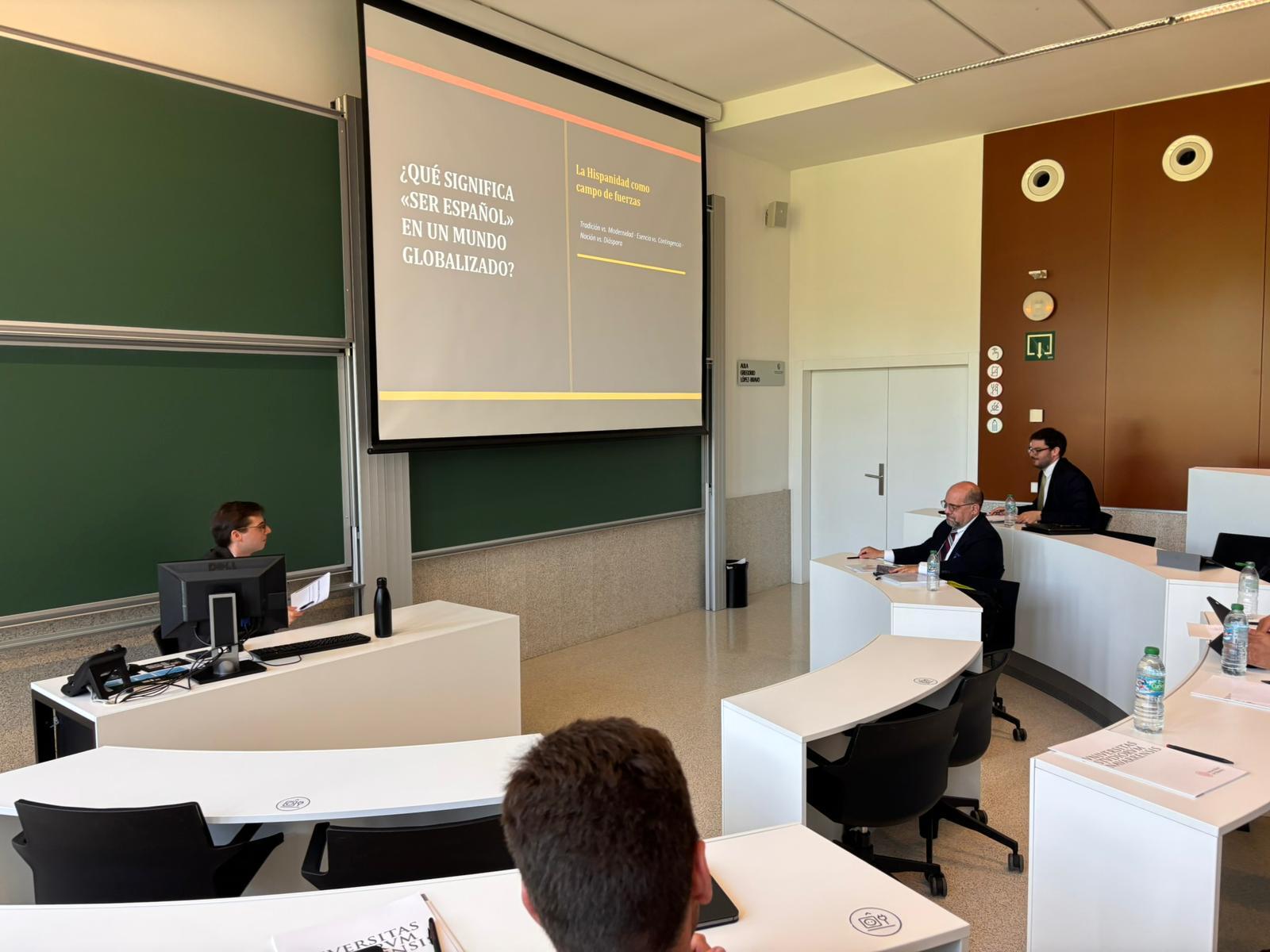
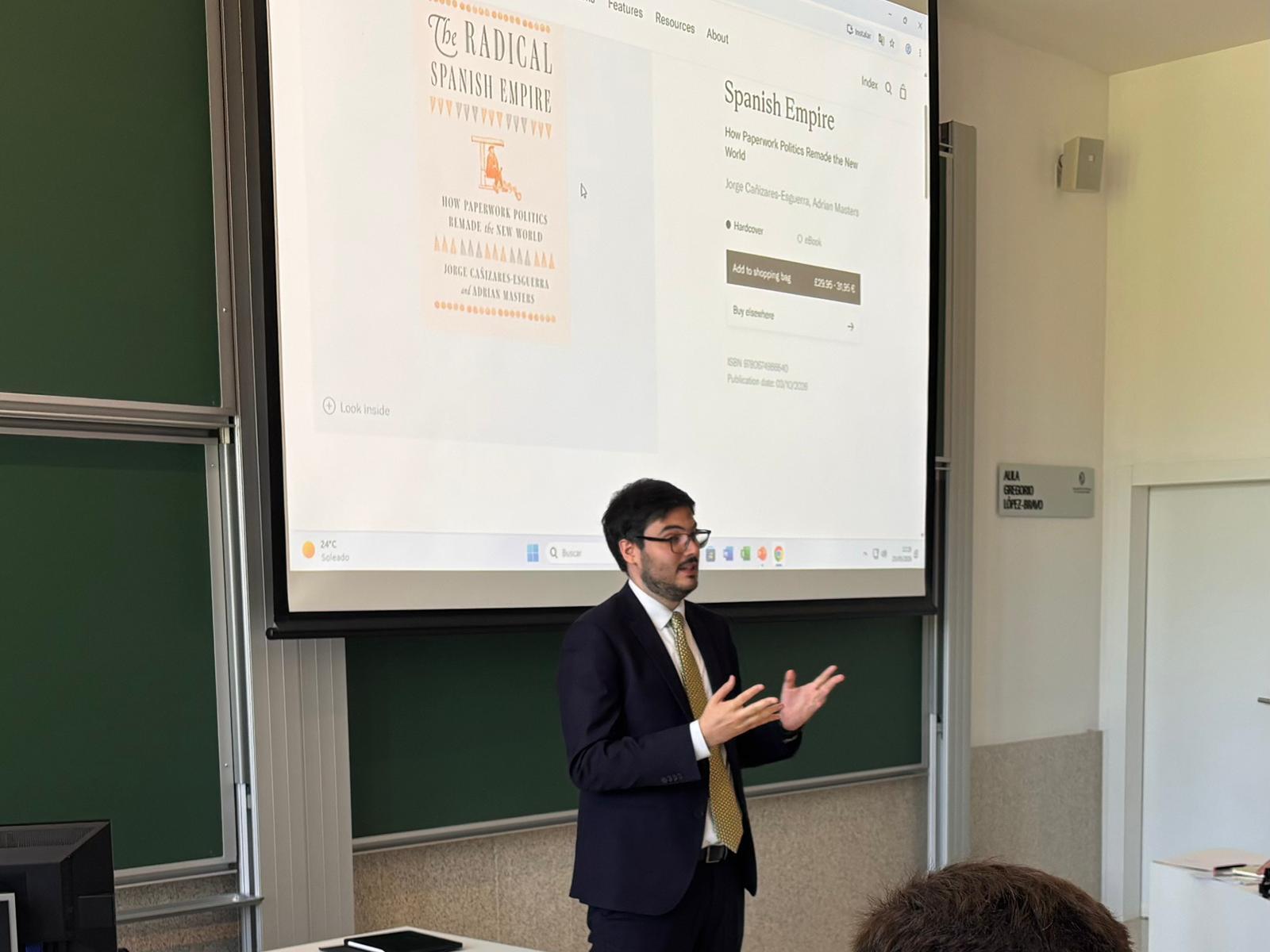
The University of Navarra hosted the fourth edition of the Hispanic Thought Days on May 25th, organized by Escuela Hispánica. The Edificio Amigos was the setting for an intellectual gathering centered around Project 1776: the research exploring the influence of Second Scholasticism political thought—and in particular the School of Salamanca—on the intellectual origins of American constitutionalism and the defense of individual freedom against absolute power.
The timing is no coincidence. In the year marking the 250th anniversary of the Declaration of Independence of the United States (1776–2026), these days helped illuminate an intellectual bridge too long forgotten: the one connecting Salamanca with Philadelphia, the Spanish political theology of the 16th century with the founding principles of the American republic.
A guiding thread: from Salamanca to Philadelphia
The event was introduced by Jorge Machín, director of Escuela Hispánica, who set out the thematic framework and recalled that Project 1776 rests on an increasingly well-documented premise: that many principles considered pillars of modern democracies—popular sovereignty, the limitation of power, respect for individual conscience—were formulated centuries earlier by the theologians and jurists of the School of Salamanca. An intellectual bridge that rewrites, in large part, our shared history.
Juan Ángel Soto Gómez opened the conference with "From Salamanca to London and Philadelphia," tracing the doctrinal ties linking 16th-century Salamancan scholastics with Anglo-Saxon political thought and with the Founding Fathers of the United States. His talk offered a transatlantic reading that placed Spain at the center of the intellectual genealogy of political modernity.
Mario Fantini presented "The Lost Hispanic Heritage of American Conservatism: A Transatlantic Recovery," arguing that American conservative thought has Hispanic roots that have been systematically overlooked, and proposing their recovery as an urgent task on both sides of the Atlantic.
Santiago de Navascués addressed the 1956–1962 period in "Reclaiming Hispanidad: Anglophiles and Hispanophiles in Search of Common References," analyzing the cultural synthesis projects between Anglo-Saxon intellectuals and Hispanists at a moment of tension and dialogue during the Cold War.
Guillermo Tejeda examined the reception of Francisco de Vitoria's doctrine on just war and the right of resistance in "Rebellion as a Reasoned Alternative: Vitoria and Just War in the Philadelphia Declaration of Independence," establishing a deeply substantive doctrinal bridge between Salamancan thought and the American founding moment.
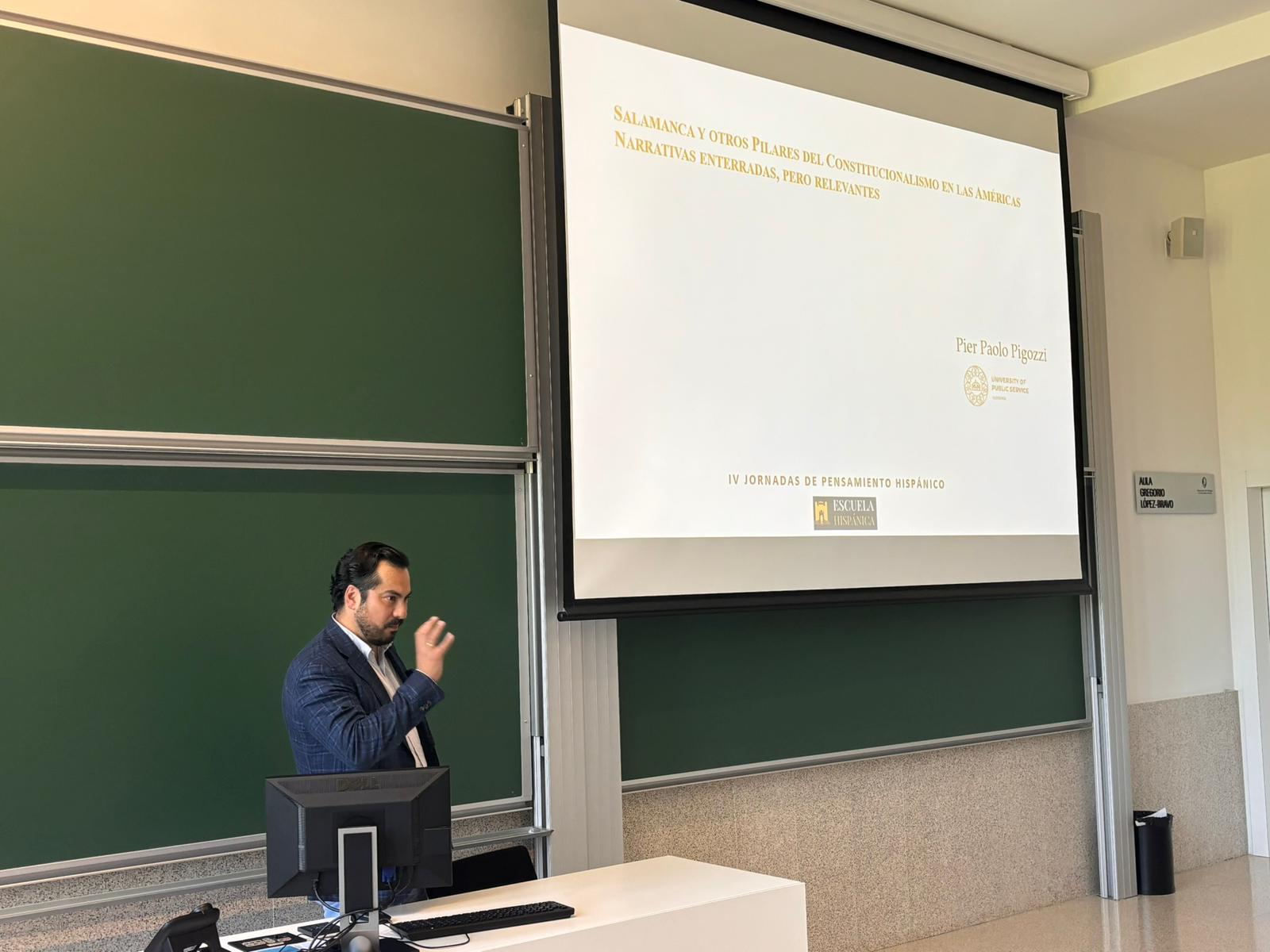
Pier Pigozzi broadened the geographic scope in "Salamanca and Other Pillars of Constitutionalism in the Americas," considering the reception of Hispanic scholastic thought not only in the United States but across the entire American continent and its role in shaping the various constitutional frameworks of the region.
The day concluded with Noah Torres' paper, "The Influence of Salamancan Theories on American Constitutionalism," focused on the intellectual genealogy of parental rights in the United States. Through a journey connecting Vitoria, Soto, and Suárez with the Anglo-American legal tradition, he highlighted how the natural law categories developed by the School of Salamanca and the Second Scholasticism continue to offer a fertile framework for understanding some of the most relevant debates in contemporary constitutionalism around family, education, and the limits of state intervention.
Closing
After the presentations, participants and speakers gathered at the Faustino restaurant for a closing lunch that extended the day's debates in a more relaxed setting, strengthening the academic bonds of a growing intellectual community.
The IV Hispanic Thought Days reaffirmed Pamplona as one of the key spaces for the study and dissemination of the Hispanic intellectual tradition, and marked a significant step forward in the development of Project 1776, whose horizon is precisely this: to demonstrate that the legacy of Salamanca is not merely Spain's history, but the shared history of the West.